.png?width=221&height=58&name=logo%20(3).png)
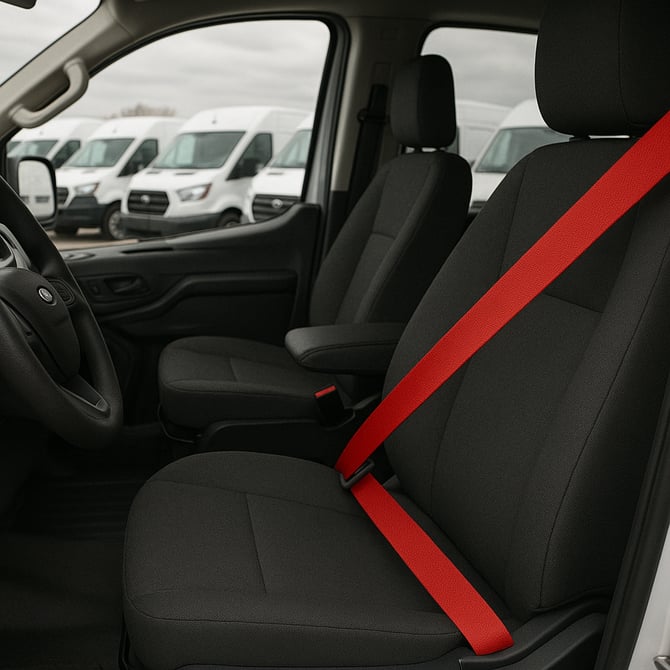
Red Seat Belts: A Small Upgrade That Changes Everything
Fleet safety directors spend a lot of time fighting the same problem: seat belt non-use.
Employees know they should wear them. Supervisors know they should enforce them. But real-world conditions get in the way.
Visibility is the root issue.
You can’t enforce what you can’t see.
Red seat belts cut through that problem instantly. They create a visible standard that reshapes behavior, reduces liability, and strengthens the company’s entire safety program.
This upgrade is simple. The impact is big.
Upgrade to red seat belts today:
https://www.myairbags.com/product/red-colors-seat-belt-webbing-replacement/
Why Seat Belt Visibility Directly Impacts Fleet Liability
Every claim, every injury, and every serious incident involving a company vehicle ultimately comes down to one critical detail:
Was the employee wearing a seat belt?
When the belt is black or gray, it’s much harder to prove.
That ambiguity becomes expensive.
With red belts, a supervisor, safety officer, or even a dash camera can confirm compliance instantly.
This clarity lowers liability in several ways:
1. Stronger claim defensibility
If an employee is buckled, you can demonstrate:
• The company enforced safety
• The operator followed protocol
• Injury severity was reduced
Insurance carriers look for this.
2. Reduced injuries and lowered claim severity
Red belts increase compliance.
More compliance equals fewer serious injuries.
Fewer serious injuries equal lower Workers’ Comp and liability exposure.
3. Clearer training and enforcement
Supervisors no longer guess or rely on verbal assurance.
Red belts give them immediate visual confirmation.
4. Better audit trails for insurance and OSHA
When a claim involves a vehicle or equipment, documentation matters.
Red belts make compliance visually obvious from the start.
Why Seat Belt Non-Compliance Still Happens
The problem isn’t that people don’t know the rules.
The problem is human behavior.
Employees skip buckling for reasons like:
• Short trips
• Rushing
• Habit
• Perceived inconvenience
• Lack of supervision
• Discomfort in bulky clothing
• Equipment contamination (dust, oil, chemicals)
Traditional belts make this easy to hide.
Red belts remove the option of being “almost buckled.”
How Red Belts Improve Fleet Safety in the Real World
1. Instant visual confirmation for supervisors
Supervisors and safety officers often monitor multiple vehicles at once.
Red belts allow them to check compliance at a distance, even during:
• Yard walk-throughs
• Warehouse inspections
• Worksite evaluations
• Pre-shift safety checks
A glance is all it takes.
2. Behavior change without confrontation
Employees quickly adopt safer habits when the expectation is visible and unmistakable.
No arguing.
No guessing.
No awkward coaching conversations.
Red belts make it obvious what “proper use” looks like.
3. Better alignment with corporate safety goals
Companies with strong safety cultures often use:
• High-visibility PPE
• Visual compliance indicators
• Color-coded controls
• Standardized safety equipment
Red belts fit perfectly into this structure.
4. Enhanced camera verification
Dash cams and in-cab video systems are widely used.
But standard belts blend into dark interiors on camera.
Red belts make belt use unmistakable in recorded footage.
Get red seat belts here:
https://www.myairbags.com/product/red-colors-seat-belt-webbing-replacement/
Industries Seeing the Biggest Liability Reductions
Delivery & Logistics Fleets
Constant stop-and-go traffic increases risk.
Construction & Utility Fleets
Field operations need fast compliance checks.
Manufacturing & Industrial Facilities
Forklifts, loaders, lift trucks, and tuggers benefit from obvious belt visibility.
Municipal & Government Fleets
Public safety and transparency matter.
Oil, Gas, and Energy Companies
High-risk environments demand clear, enforceable protocols.
Across all sectors, red belts reduce incidents and strengthen legal defensibility.
Common Questions
“Do red seat belts reduce company liability?”
Yes. Red belts improve compliance and make it easier to verify proper belt use, which reduces injury severity and strengthens claim defenses.
“Why do fleets switch from black to red seat belts?”
Red belts solve visibility problems. Supervisors and cameras can confirm compliance instantly.
“Are red seat belts legal for commercial fleets?”
Yes. OSHA and DOT do not restrict belt color as long as the belts meet safety standards.
“Does upgrading to red belts require new hardware?”
No. Most fleets simply reweb the existing belts with new red material.
“Do insurance carriers recommend high-visibility belts?”
Many safety consultants do. Better compliance means fewer severe claims.
How Red Seat Belts Fit Into a Larger Safety Strategy
Upgrading to red belts is only one step, but it supports critical safety goals:
• Reduce recordable incidents
• Build a culture of visible compliance
• Strengthen accident investigations
• Improve training outcomes
• Lower insurance costs
• Reduce operational downtime
Red belts make seat belt enforcement a passive system instead of a daily battle.
How the Rewebbing Process Works for Fleets
Most companies don’t replace the whole belt assembly.
They send the belts in to be rebuilt with new red webbing.
MyAirbags handles:
• Removal of old webbing
• Installation of new OEM-grade red webbing
• Mechanism inspection
• Retractor repair if needed
• Final testing
• Fast turnaround
• Fleet-scale ordering and tracking
The belts come back ready to reinstall and fully functional.
Upgrade Your Fleet to Red Seat Belts
MyAirbags provides OEM-grade red seat belt webbing replacement for companies that need higher visibility, stronger compliance, and reduced liability. This upgrade gives fleet supervisors and safety teams the visibility they need to enforce rules without constant intervention.
Upgrade your fleet here:
https://www.myairbags.com/product/red-colors-seat-belt-webbing-replacement/